Ms. Johnson’s 8th graders didn’t just study smoking— they spent the year working to extinguish it.
What did they care about?
Disturbed by how many people smoked in their community, 8th graders at ICS West wanted to do something about it.
What did the students learn?
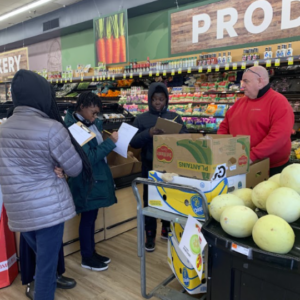
The students’ interest in smoking started with a survey of ICS West students. The prevalence of smoking that the survey uncovered in their own student population led them to do a neighborhood survey at Great Valu Market, their local supermarket. With the market’s support, students gathered data by interviewing shoppers, which confirmed what a problem smoking was in their community.
They met with neuroscientists from Temple University to talk about the research around addiction. Drs. Kirby and Ward helped students to understand how even just “trying one cigarette” when a student or community member was as young as 9 or 12 (this mirrored the stories they heard at Great Valu from members of the community) could cause someone to start smoking, and that inspired them to work harder to get people to not start in the first place.
Drs. Kirby and Ward’s visit also helped take the blame/shame/judgement off of people with addiction by explaining the chemistry behind addiction, the incredible POWER of drugs to impact the brain, and how the stigma attached to addiction has made it so hard to study and create medicine to treat it.
The students also met with public health advocates from the Advocacy Institute, Marquita Young and Sara Guiang, who shared how big tobacco targets young people, Black and Brown people & urban communities, how it kills 500k people each year, and how vaping is just as bad for you as smoking.
Guiang and Young also addressed the systemic nature of this problem, including how tobacco can be marketed as a solution to problems (i.e. smoking will help you feel calm – which it doesn’t), how smoking is normalized in urban communities (and less so in white/suburban areas), and how their organization is very much not anti-smoker, but anti-Big Tobacco.
What did the students do about the issue?
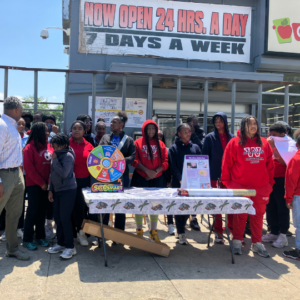
By spring, the students launched a full public health campaign- including permission from Great Valu Market for a permanent, student-made anti-smoking installation at the market as well as a day of public education. The opening day of the campaign included an unveiling of the installation along with an interactive display outside the market where students spoke with neighbors.